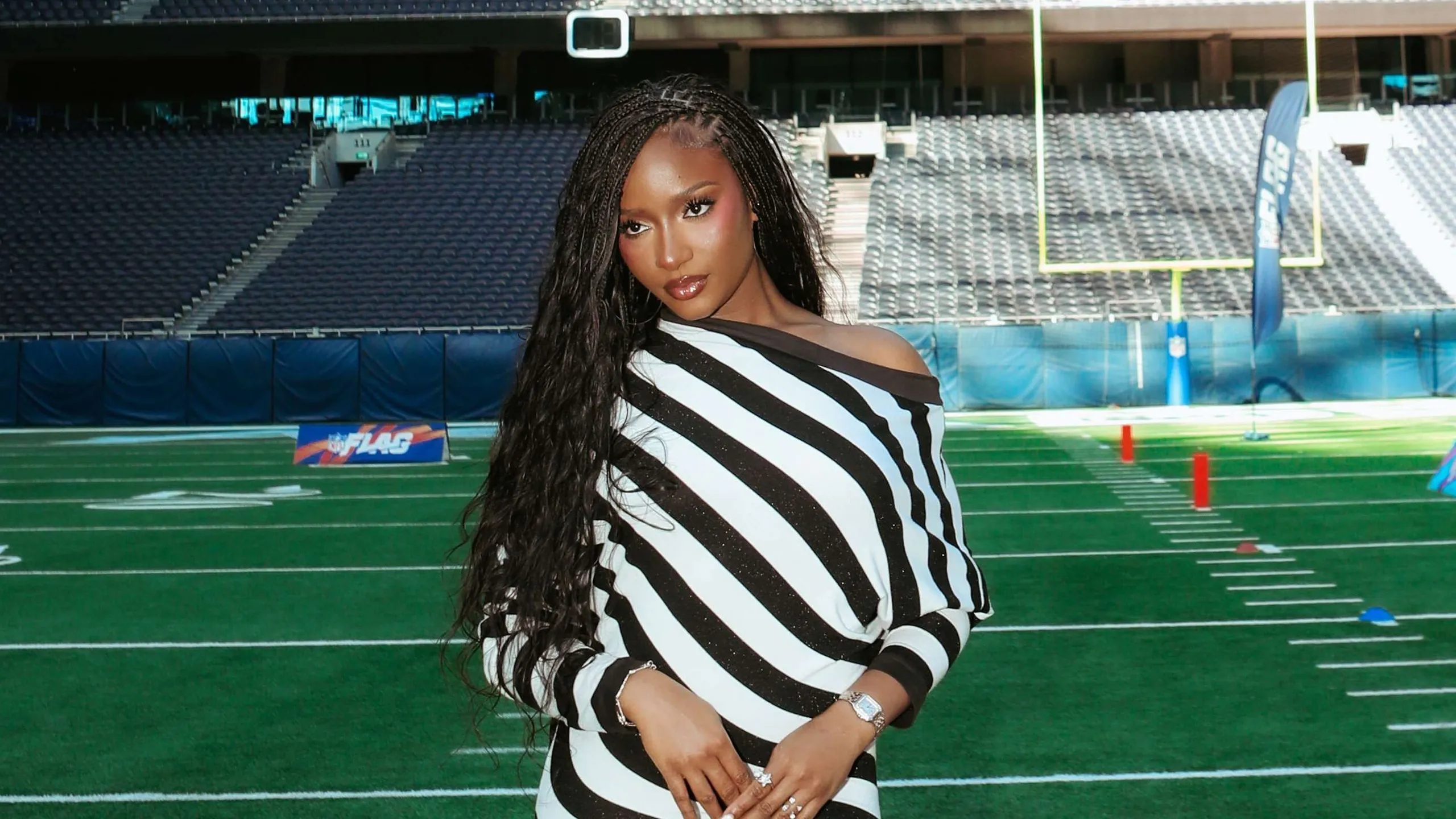
Today, October 11, 2026. Tottenham Hotspur Stadium, London. The Philadelphia Eagles versus the Jacksonville Jaguars. Halftime.
And on that stage in front of tens of thousands of fans, broadcast live across the UK on Channel 5 and Sky Sports, streamed globally a 23-year-old Beninese-Nigerian woman from Lagos stepped out and headlined the show.
Ayra Starr just became the first major African artist to headline an NFL halftime performance.
Let me say that again, because it deserves to be said slowly.
The first.
In the entire history of the NFL a league that has existed since 1920, that generates over $18 billion in annual revenue, that stages the most-watched television event on the planet every year no African artist has ever headlined a halftime show.
Until today.
Why this matters beyond the music.
It would be easy to treat this as just another booking. Just another concert. Just another gig on Ayra Starr’s increasingly insane calendar.
But that would miss the point entirely.
The NFL halftime show is not just a concert. It is one of the most visible stages in global entertainment. It is the stage where Michael Jackson redefined what a live performance could be. Where Beyoncé made political statements. Where Shakira and Jennifer Lopez represented an entire hemisphere. Where Rihanna performed while pregnant and made it look effortless.
That stage has always been reserved for a very specific kind of artist the kind the American entertainment industry considers “global.” And for decades, “global” meant American. Or British. Or Latin. Never African.
Afrobeats has been the fastest-growing genre in the world for five years. Burna Boy fills stadiums across four continents. Wizkid has collaborated with Drake, Beyoncé, and Justin Bieber. Davido has performed at the World Cup. Tyla won a Grammy. And none of them have headlined an NFL halftime show.
Ayra Starr 23 years old, three albums deep, seven billion global streams, two Grammy nominations is the one who broke through.
The NFL called her “a generational talent.”
Read that phrase carefully.
Tim Tubito, the NFL’s senior director of global game presentation, didn’t call her “an exciting new artist.” He didn’t call her “a rising star.” He called her “a generational talent with a real connection to fans in this market.”
That language matters. “Generational talent” is the phrase the NFL uses for people like Patrick Mahomes and Travis Kelce. It’s not a compliment they hand out casually. It’s a signal to sponsors, to broadcasters, to the industry that this person is operating at a level that transcends their category.
The NFL didn’t book Ayra Starr because Afrobeats is trendy. They booked her because she fills the room. Because Starrgirl debuted with collaborations with Wizkid, Rema, and ZAYN and nobody questioned whether she belonged in that company. Because “Where Do We Go” has 1.3 billion streams and climbing. Because she performed at Glastonbury and the crowd sang every word back to her.
They booked her because she earned it.
From Lagos to London to the NFL.
I keep thinking about the geography of this moment.
Ayra Starr was born in Cotonou, Benin. She grew up in Lagos, Nigeria. She was signed by Don Jazzy’s Mavin Records at 18. Her debut album was called “19 & Dangerous.” She was by any traditional music industry standard nowhere near the NFL’s radar.
And yet here she is. At Tottenham Hotspur Stadium. In front of a crowd that paid to watch American football and got Afrobeats at halftime. On a stage that Rihanna and Beyoncé have stood on.
The path from Lagos to this stage didn’t exist five years ago. Ayra Starr didn’t find the path. She built it.
And the seven halftime shows the NFL is staging this season across seven countries and four continents tell you exactly where the league sees the future of its global entertainment strategy. It’s not just American anymore. It’s everywhere. And Africa is finally on that map.
What this means for what comes next.
This is the part where I zoom out. Because Ayra Starr’s NFL moment isn’t just about Ayra Starr.
It’s about every young African artist who has been told explicitly or implicitly that there’s a ceiling. That Afrobeats can go viral on TikTok but not headline in stadiums. That African music can win a Grammy category created specifically for it but can’t compete on the main stage.
Ayra Starr just proved that the ceiling is a lie.
And she did it at 23. With her third album barely two months old. With her entire career still ahead of her.
I wrote on this blog a few weeks ago about Angélique Kidjo becoming the first African musician to receive a star on the Hollywood Walk of Fame. She was 66 when it happened. It took four decades.
Ayra Starr is 23. The doors are opening faster now. Not because the industry suddenly became generous but because artists like Burna Boy, Wizkid, Tyla, and Angélique Kidjo spent years pushing against them until the hinges gave way.
Ayra walked through. And she didn’t just walk she performed.
A final thought.
Somewhere in Lagos tonight, a teenage girl is watching clips of Ayra Starr on the NFL stage. She’s watching a woman who looks like her, who sounds like her, who comes from where she comes from standing on a stage that was never supposed to be hers.
And that girl is thinking: maybe I can do that too.
That’s what representation does. Not the corporate kind. Not the PR kind. The real kind the kind that happens when someone who wasn’t supposed to be there shows up anyway and makes the whole room remember why live music exists.
Ayra Starr didn’t just perform at halftime today. She rewrote what halftime can look like.
And Afrobeats didn’t just reach the NFL. It arrived.
Christ-Yvan 🛶